 By admin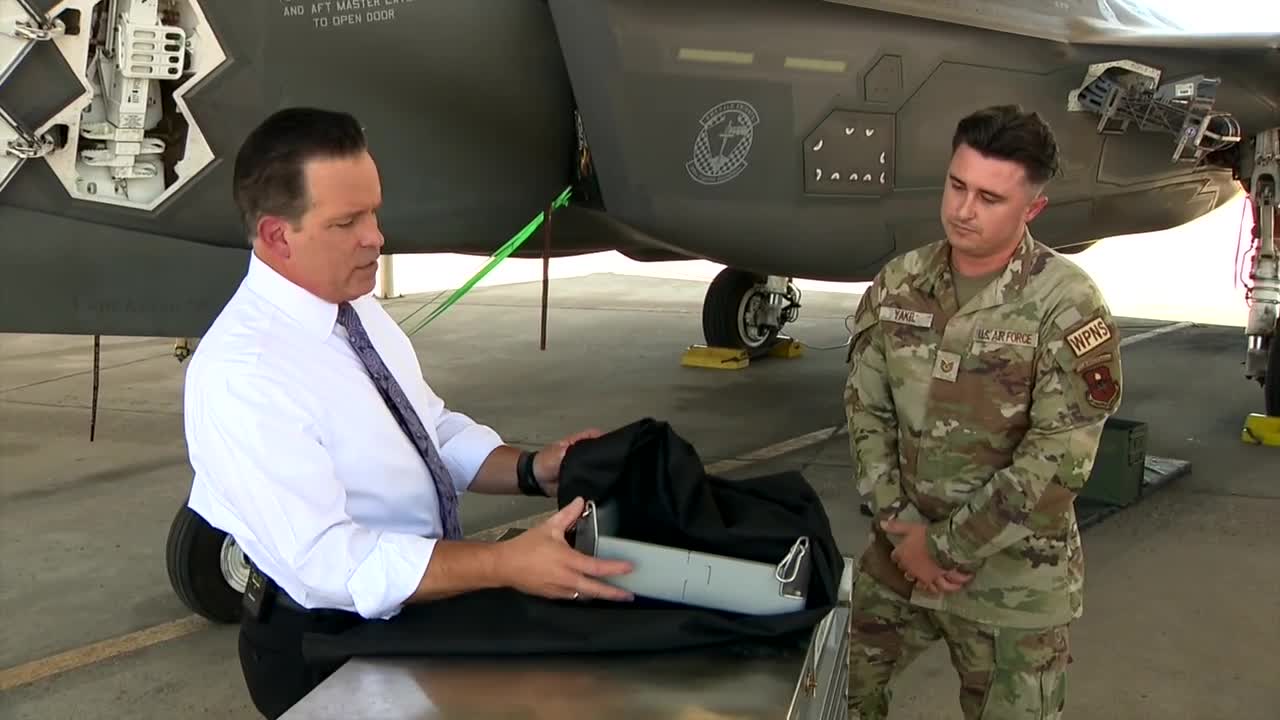
On a flight line dominated by one of the world’s most advanced fighter jets, two Air Force weapons airmen have solved a stubborn problem with a solution that costs less than $100.
Read more Arizona freshman Brayden Burries selected No. 10 by Milwaukee in 2026 NBA Draft
Tech. Sgt. Zach Allbee and Tech. Sgt. Nik Yakel, weapons specialists with roughly 15 years each in uniform, helped design a simple attachment that keeps spent ammunition casings from scattering under F-35A Lightning II jets — a foreign object debris hazard that can sideline an aircraft and cost the Air Force millions.
The device, nicknamed Project ZACH for Zero Point Ammunition Cartridge Handler, guides used brass from the aircraft’s internal loading mechanism into an ammo can instead of bouncing across the concrete. What sounds minor on paper can be mission-critical on the ramp.
“If one of those cases gets picked up by an aircraft and damages its engine, that’s 20-plus million dollars out the door,” Allbee said, describing how a single casing left on the flight line can be sucked into an intake.
For years, weapons crews downloading the F-35’s gun system relied on gravity and good aim. As the aircraft’s spent casings dropped more than six feet from the device used to load and unload ammunition, airmen tried to “eyeball” them into an ammo can. Many missed.
Allbee estimates he has loaded and unloaded 200,000 to 300,000 rounds over his career, from A-10s to F-35s. He said even experienced crews routinely lost brass during a download.
“Nine times out of 10, you’re not catching all the rounds in the ammo can,” he said. “During the day, it’s a little bit easier, because I can see where they all went. If you were to do this at night … now you have a piece of hard metal FOD sitting on the flight line that you don’t know about.”
Yakel, the maintenance noncommissioned officer in charge of the 308th Weapons Flight, said the problem did more than create a safety risk — it disrupted the rhythm of the load crews.
“Loading is very solidified. Everybody has their steps. There’s a motion — it’s very graceful when it’s put together well,” Yakel said the unloading process disrupts that. “Having to stop your rhythm … to chase rounds around the aircraft and adding the added stress of aircraft running around — it’s a giant vacuum.”
Watching brass “go everywhere” during one gun download, Allbee and Yakel started spit balling ideas on the spot.
“I just thought to myself, that can’t be the best way to do this,” Allbee said. “What if we just come up with something to help guide those casings down into the ammo can, that way I don’t have to worry about them going anywhere — day or night.”
The pair took the idea up their chain of command, gathered feedback from other units using the same expedient loader, and confirmed the problem was widespread, not just a training issue at Luke.
With support from their commander and help from civilian engineers at Detachment 9 on base, they built a prototype using a 3D-printed bracket and mesh netting scavenged from the arts and crafts store. That early concept evolved into a more rugged design: a three-piece 3D-printed bracket that clamps to the existing chute and a heavy canvas funnel that directs all brass into the can.
“Standard canvas material, all-weather, super durable, anti-rip, anti-tear,” Allbee said. “So far it works pretty good — and not to mention this costs less than our original prototype. This is about $100.”
Read more Person dead after shooting involving DPS detectives near 28th Street and Camelback Road in Phoenix
For an aircraft with a price tag that can top $80 million, the contrast isn’t lost on the crews who use it.
“When you think about a $98 fix for something as expensive as this, that’s pretty incredible,” Allbee said.
The simple add-on does not alter the aircraft or the original loader design, a key factor in gaining approval to move forward. The attachment hangs from the existing expedient loader structure and can be replicated by other units using shared design files.
The team is now preparing to distribute the design to other F-35 units at Luke for additional testing and feedback. Once refinements are complete, they plan to place the design in the Air Force’s global system so any F‑35A unit can build its own version for under $100.
For Yakel, the impact goes beyond hardware. He sees it as a tangible way to leave the service better than he found it.
“Does it cost tens of millions of dollars? No,” he said. “But the fact that we’re able to keep this to roughly $98 and still have such a big impact is huge.”
He imagines a future where younger airmen — maybe even a grandchild — are working on F-35s and treating Project ZACH as just another standard tool on the line.
“It’d be really cool to have a grandchild that serves and says, ‘Yeah, I was watching these weapons guys, they had this chute thing,’” Yakel said. “I’d be like, ‘You’re not going to believe this, but…’”
Leaders say the device reflects a broader push inside the Air Force to encourage airmen-led innovation, especially at training bases like Luke, where every sortie counts.
Master Sgt. Austin Fahad described his reaction when the airmen brought the problem — and their solution — forward as simple pride.
“The ability to recognize a problem and be willing to vocalize it, not accepting that problem as reality — that’s huge,” he said, adding that the airmen “went through the long haul” of prototyping, networking and gathering data from other bases to get to a final product.
As Luke continues training combat pilots for the F-35 fleet, Allbee and Yakel say the real reward will be seeing their invention in use on other ramps around the world.
“It may not be spectacular to look at,” Yakel said, “but it’s something kind of cool that we’re proud of — taking care of our guys and taking care of the aircraft. Those are number one and number two for us.”
Read more Things to do: Beauty and The Beast, Nate Bargatze, AZ Toy Con Mesa Mega Show & more!