 By admin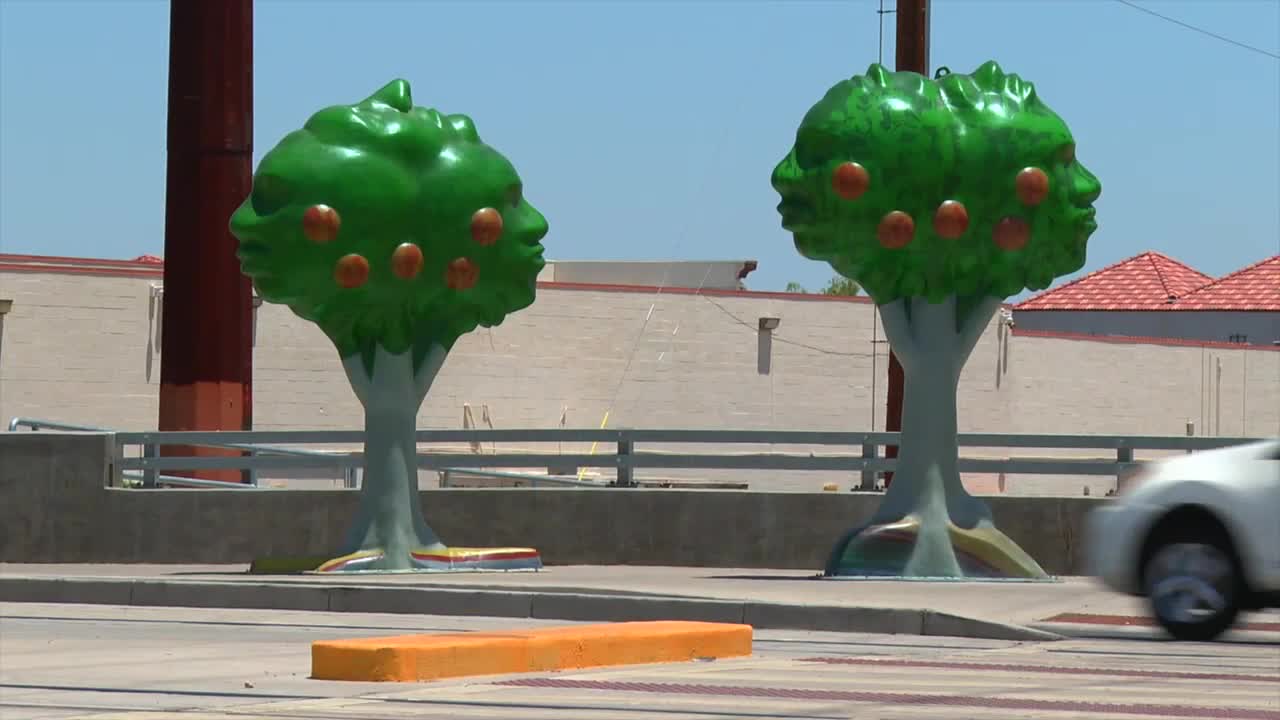
PHOENIX — More than one thousand comments on a viral social media post are mostly calling two orange tree sculptures in South Phoenix “tacky”, a “waste of tax dollars”, and even “butt ugly”.
Read more Weekend traffic advisory: closures on SR 51, Loop 101, Loop 202 (July 10-13)
The post was made on X by an account called “WallStreetApes” which has more than one million followers. The video was viewed more than 250 thousand times.
The city of Phoenix Arizona installed these new orange tree art installations
Phoenix residents see them as an eye sore, ugly and a big waste of taxpayer money
I couldn’t find an exact dollar amount on how much these cost but similar pieces like this have cost cities as much as… pic.twitter.com/ljOOCKWNv9
— Wall Street Apes (@WallStreetApes) July 1, 2026
ABC15 set out to fact-check that claim and learned that the project cost even more than what the post claimed. We also learned it was missing context and a bit more complicated.
The project for the trees was not commissioned by the City of Phoenix, but rather Valley Metro as part of their South Phoenix light rail extension.
Valley Metro confirmed to ABC15 that the trees are part of a larger art project called “Rio” which is at the stop at Central and Baseline. The project includes the trees, an installation on a building at the park-and-ride lot, and a statue that hasn’t been installed yet.
Valley Metro says the cost for “Rio” was $350,000.
“Community members helped select the artist and provided feedback throughout the design process,” A Valley Metro spokesperson said in an e-mailed statement. “The artwork reflects stories, history and cultural themes shared by the surrounding community as part of Valley Metro’s ongoing investment in creating transit spaces that are functional, welcoming and representative of the neighborhoods they serve.”
George Bates is the New Jersey-based artist who created the art piece. As a long time public artist he says the online reaction wasn’t unusual.
“Reading the comments, they were pretty typical for the backlash against public art,” Bates said.
Bates said there’s more than meets the eye when it comes to “Rio”. Etched into the trees are different stories he heard while researching the project.
“The trees themselves are essentially an homage to the citrus groves,” Bates said. “Just the entire experience of living in South Phoenix area, the history of local workers, agriculture workers, migrant workers and how important that was.”
Bates says one of the biggest misconceptions with public art projects is that the artists themselves receive the entire budget.
Read more Former Tucson-area mental health counselor arrested on child exploitation charges
“Absolutely not,” Bates said. “The artist fees are like 18 to 20 percent of that entire budget.”
Bates said most of the funding went toward designing, engineering and fabricating the artwork. He said he intentionally chose to work with local Phoenix fabricators to keep the money local.
“Like $295,000 went to the fabricator. So that was money that went right directly back into Phoenix,” Bates said. “if I can put that budget back into the local community, I’m always looking to do that.”
Bates used local business “American Fiberglass” to make “Rio”. Bates says he found them through a recommendation from a member of the South Phoenix community.
“Most folks have no way of knowing how much money it really costs to make something,” Walker Donaldson, the manager of American Fiberglass said. “The vast majority of that budget went into the paychecks of local craftspeople who punch a clock every day.”
The orange tree sculptures in the “Rio” project also light up at night.
Rio is one of 19 projects installed along the South Central extension. According to Valley Metro, approximately $3.6 million was spent on artwork throughout the corridor.
Like many large public infrastructure projects across the country, the artwork was funded through a public art allocation tied to the overall construction project. Oftentimes art is 1% of the total construction budget.
“The public art budget was established under Valley Metro’s Board-approved policy allowing up to 1% of a project’s construction budget to support public art,” Valley Metro said.
Whether people love or hate the orange trees, or the entire “Rio” piece, Bates said he hopes the viral attention encourages people to spend time in South Phoenix beyond simply driving past the sculptures.
“Come for the art, like the art, don’t like the art, but really just come down for the people, the culture, the area, and spend that time,” Bates said.
Read more Here’s a list of indoor attractions in the Valley to help you beat the summer heat